5G, full bars, nothing loads: Or how I learned to start learning with LLMs
I was standing in a packed Berlin Hauptbahnhof, waiting for a train to Amsterdam. My phone showed full-strength 5G, but I couldn’t load a page to check the train times (and of course the train I was planning to take was cancelled). I’m a big fan of rabbit holes, so I jumped in. I had a few hours and was about to learn what 5G actually means (spoiler: a lot of it is marketing).
The journey made me realise how we can be learning from now on: with an answers machine at your fingertips, speaking your preferred learning style including visuals and back-and-forth questions like a socratic conversation. There are a ton of opportunities to learn something new in a way that’s a 100 times more engaging than your math teacher waiting out the days until his retirement. I have a massive respect for teachers, but unfortunately not everyone has their heart in it all of the time, whether it’s because of a bad night of sleep or a wrong turn at the career fair.
Lost in the crowd
When you’re at the station the tower is loud and close, so your phone reports a strong radio link and all bars covered. But a cell has finite capacity, and its scheduler has to divide radio resources across everyone using it. The bars only show the radio link, not the capacity currently available to you.
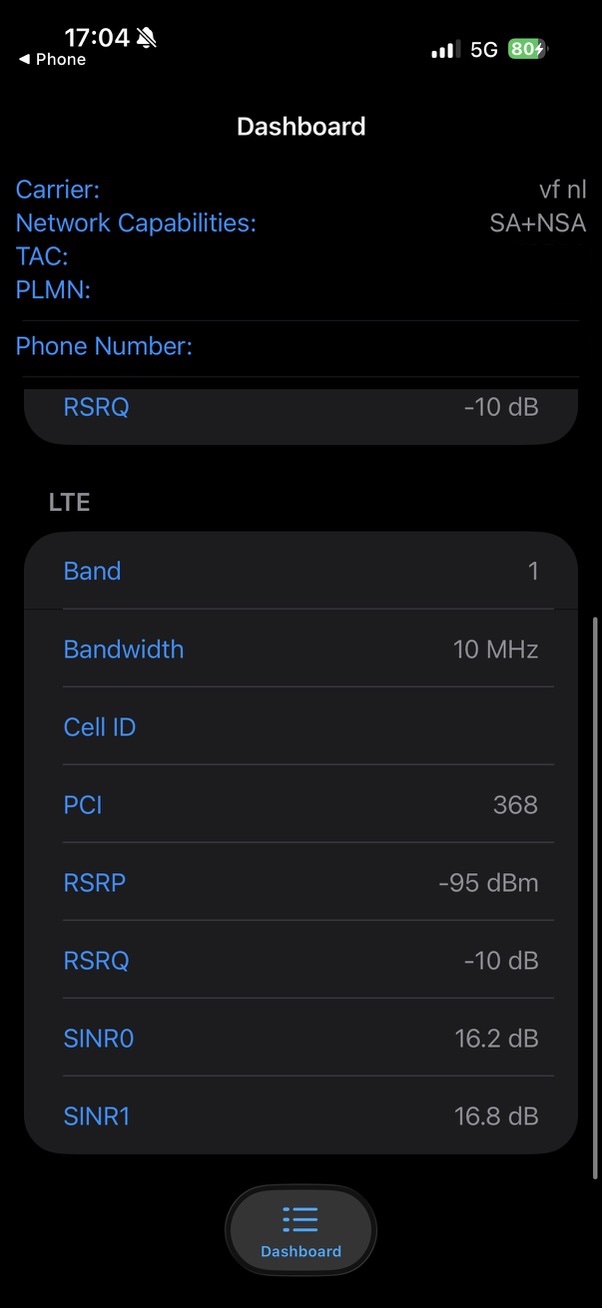
Android can derive its bars from configurable combinations of RSRP, RSRQ and SINR. They measure power, signal, noise and quality but none is a direct measurement of your available throughput. Android’s signal-strength documentation explains how those measurements can be used for the five displayed signal levels. If you’re interested in viewing signal strength on your iPhone, just “call” *3001#12345#* and a screen with all these metrics in real time will open up.
Behind the glass
I boarded the train to escape the crowd. My connection got worse. A train window looks like glass but can behave like a mirror. The metallised coating on the outside that keeps the carriage cool also reflects radio waves, turning the car into a partial Faraday cage. Step inside and the same tower may have to punch through it. Move yourself in and out below and watch three useful measurements: strength, quality and signal-to-interference-plus-noise ratio.
The strength icon only loses a bar, but SINR falls off a cliff, pushing the connection toward a sturdier, slower modulation. It’s like with one step you move 100 people to a remote location in the country side with poor reception while everyone’s phone starts shouting louder to reach the same tower. You get closer to or beyond the noise floor of your phone’s built-in equipment and it drops from dense 64QAM to QPSK and the stream turns to pixels.
The effect varies by train. Deutsche Bahn uses repeaters, external antennas, laser-treated windows and newer signal-permeable windows to improve reception. Its TrainLab overview explains both the problem and those mitigations.
On board: the shared roof
Your phone may fight the glass on one mobile network, but the train has external antennas and multi-provider equipment that uses available networks in parallel and bundles them into onboard Wi-Fi. That makes the connection more resilient, but every passenger still shares the result. Fill the train below and watch what happens.
External antennas and multiple mobile networks can beat one Faraday-trapped SIM until the shared connection fills up. Multi-provider technology improves the flow into the train; it does not make that flow infinite.
At speed · open country
Out between towns, 5G isn’t one continuous blanket. In a common non-standalone (NSA) setup, a faster mid-band 5G layer can sit on top of a longer-reaching LTE anchor. This is called 5G NR for New Radio. As the train races between masts, that NR leg may attach and drop while LTE remains available.
This is a common form of NSA 5G: an LTE anchor with a faster but shorter-reaching NR leg on top. It explains one way the icon and the experienced speed can tell different stories: a strong LTE signal with the 5G ‘brand’ does not mean a fast connection.
Apple also notes that the 5G icon depends on carrier configuration. It is a status hint, not a speedometer.
Learning by chasing a contradiction
Since you made it down here, you now know as much about 5G as I do and I didn’t know anything about before writing this. I didn’t begin by asking Claude to “teach me 5G.” I began with something I was curious about. The answer gave me a better question: if the bars don’t measure usable capacity, what do they measure? From there, every answer exposed another layer.
Why did the connection get worse after I stepped onto the train? How could the train’s Wi-Fi work when my phone could not? Was everyone in the carriage sharing the same connection? Why did the 5G icon blink on and off once we were moving through open country?
The useful part wasn’t getting a single authoritative answer. It was being able to keep narrowing the question without first learning all the vocabulary. Terms such as RSRP, RSRQ, SINR, modulation and non-standalone 5G appeared when they became relevant, attached to something I had just observed. I could ask the naive follow-up immediately instead of pretending I understood it.
Turning the answers into an interactive visualization changed the process again. Text can hide a flaky mental model, a clear visualization with controls can not. Building the explanation became a way of testing whether I understood it.
That is the part of learning with AI that I find most useful: not asking for a finished explanation, but using the conversation to move from a real observation to a model you can question. The model will still be incomplete. The final step is making those gaps explicit, working through them with analogies to see what holds and what doesn’t and checking the important claims against sources outside the conversation.
What this model leaves out
The numbers are illustrative, not measurements from my journey. The first divides a simplified cell capacity equally between users when real schedulers allocate radio resources dynamically based on demand, radio conditions, device capabilities and network policy. Android’s own documentation also shows why “the bars measure signal strength” is still shorthand: carriers can configure 4G and 5G bars from combinations of RSRP, RSRQ and SINR. What those bars do not show directly is the throughput currently available to you.
The train is simplified too. Deutsche Bahn documents both the reception problem caused by metallic window coatings and the equipment used to mitigate it: repeaters, external antennas, laser-treated windows and newer signal-permeable windows. Its onboard Wi-Fi combines available mobile networks into a shared connection, but the precise implementation and performance vary by train, route and load.
Finally, the LTE anchor and 5G NR overlay show a common non-standalone 5G architecture, not a diagnosis of the network my phone used that day.
Sources
- Android Open Source Project: Signal strength reporting
- ETSI / 3GPP TS 38.215: NR physical layer measurements
- Deutsche Bahn: Telefonieren und Surfen im Zug
- Deutsche Bahn: WIFIonICE and cellular reception
- Deutsche Bahn: The fastest lab on rails
- 3GPP: 5G system overview
- Apple Support: Use 5G with your iPhone